mandarin tree
Transform Your Garden into a Personal Paradise!
Add Your Heading Text Here
How to Grow a Mandarin Tree (Complete Growing & Care Guide)
Mandarin trees are one of the most widely grown citrus trees in home gardens due to their compact size, reliable fruiting, and sweet, easy-to-peel fruit. They are well suited to both in-ground planting and container growing, making them accessible to a wide range of gardeners.
Botanically classified as Citrus reticulata, mandarins belong to the broader citrus group and are closely related to sweet oranges. Compared to oranges, mandarin trees are generally smaller, earlier to fruit, and more adaptable to pots. With proper care, mandarin trees can remain productive for decades.
Environmental Requirements
Mandarin trees perform best when grown under stable, favourable conditions. While they tolerate a range of environments, consistent sunlight, drainage, and airflow significantly improve flowering and fruit quality.
- Sunlight: Mandarin trees require full sun for optimal growth and fruiting. A minimum of 6โ8 hours of direct sunlight per day is recommended.
- Climate: Best suited to warm temperate and subtropical regions. They tolerate mild cold but are vulnerable to severe frost.
- Soil: Free-draining soil is essential. Poor drainage leads to root stress, nutrient uptake issues, and leaf yellowing.
- Air circulation: Good airflow around the canopy helps reduce disease pressure and supports healthy leaf development.
Growth Habit and Tree Size
Mandarin trees develop a naturally rounded canopy and moderate growth rate. In the ground, trees may reach several metres in height depending on variety and rootstock. When grown in containers, size is naturally limited, making long-term maintenance easier.
Pruning can be used to shape the canopy and control height without significantly reducing fruit production. Healthy trees maintain a balance between vegetative growth and fruiting wood.

Propagation and Establishment
Mandarin trees can be grown from seed, cuttings, or purchased as grafted nursery plants. Each method produces a healthy tree, but growth rate and fruiting reliability vary.
Seed-grown mandarin trees require patience. They take several years to reach maturity and may not produce fruit identical to the parent plant. For most home gardeners, grafted trees are preferred because they fruit sooner and more predictably.
Cuttings can be successful in controlled conditions but are less common for home propagation. Regardless of method, young trees should be protected from temperature extremes during establishment.
Planting Location and Timing
Mandarin trees should be planted in a sunny position with good drainage. Avoid low-lying areas where water collects, as citrus roots are sensitive to prolonged moisture.
The ideal planting period is during mild weather, allowing roots to establish before heat or cold stress. When planting in the ground, ensure the root collar remains slightly above soil level to prevent rot.
Growing Mandarin Trees in Pots
Mandarin trees adapt exceptionally well to container growing. This makes them suitable for patios, balconies, and small gardens. Containers should be large enough to support root development and must include drainage holes.
Because nutrients leach more quickly from pots, container-grown mandarin trees require closer attention to watering and feeding. Despite this, potted trees can be just as productive as in-ground trees when properly managed.

Water, Soil Structure and Root Health
Root health is the foundation of mandarin tree performance. Even a well-fed tree will struggle to grow, flower, or fruit if its roots are stressed. For mandarins, the most common causes of root stress are excess moisture, compacted soil, and poor oxygen availability.
Watering depth and frequency
Mandarin trees respond best to deep, infrequent watering rather than shallow, frequent irrigation. Deep watering encourages roots to grow downward and outward, improving drought tolerance and nutrient uptake. Between watering, the upper soil layer should be allowed to partially dry.
Constantly wet soil prevents oxygen from reaching the roots. This reduces root efficiency and often leads to yellowing leaves, weak growth, and poor fruit retention even when nutrients are present.
Soil drainage and structure
Free-draining soil is essential for mandarin trees. Heavy or compacted soil restricts root expansion and traps moisture around the root zone. Over time, this leads to chronic stress and declining productivity.
In garden beds, drainage can be improved by planting on slight mounds or raised areas. In containers, drainage holes must remain unobstructed, and pots should be elevated slightly to prevent water pooling underneath.
Root health and nutrient uptake
Healthy roots are required for effective nutrient uptake. When roots are stressed, mandarin trees may show deficiency symptoms even when fertiliser is applied. This is why correcting watering and soil issues should always come before increasing fertiliser rates.
Once root conditions are stable, nutrient uptake improves naturally and leaf colour, growth strength, and flowering reliability begin to recover.

Nutrition, NPK Balance and Long-Term Tree Stability
Mandarin trees require consistent, purpose-built nutrition to maintain a balance between vegetative growth and fruit production. Unlike fast-growing ornamental plants, mandarins perform best when growth is steady and controlled rather than excessive.
Why citrus-specific nutrition matters
General-purpose fertilisers often supply too much nitrogen, which pushes leaf growth at the expense of flowers and fruit. Mandarin trees may look healthy under these conditions but produce poor crops, drop flowers prematurely, or fail to hold fruit.
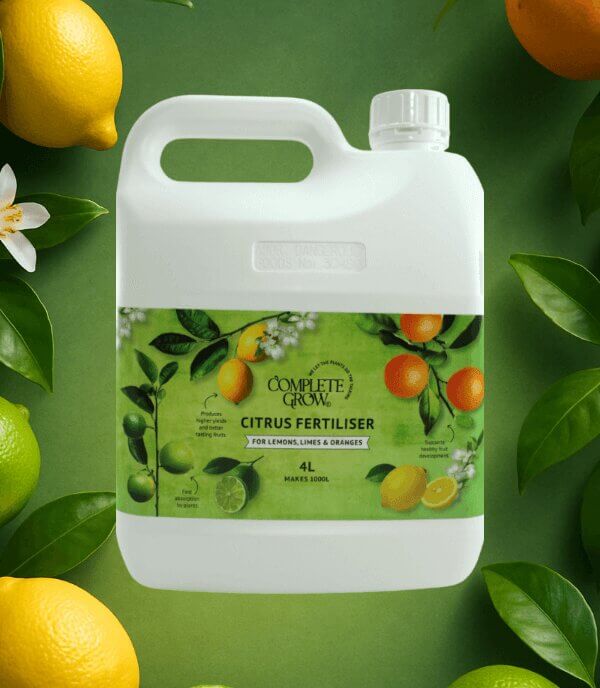
Using a citrus fertiliser designed specifically for citrus plants ensures nutrients are delivered in ratios that support flowering, fruit set, and fruit quality rather than excess foliage.
Understanding NPK balance for mandarin trees
Mandarin trees benefit from moderate nitrogen levels to support leaf health, combined with higher potassium to drive flowering and fruit development. Phosphorus plays a supporting role in root function and early establishment but is required in smaller amounts once the tree is established.
A citrus fertiliser formulated around an NPK ratio of 6-2-12 aligns closely with mandarin tree requirements. This ratio supports steady canopy growth while strongly favouring flower retention, fruit size, sweetness, and overall fruit quality.
The role of calcium and magnesium
In addition to NPK, mandarin trees rely on calcium and magnesium for long-term health and productivity. Calcium supports strong cell walls, improving fruit firmness and reducing stress-related fruit drop, while magnesium is essential for chlorophyll production and efficient photosynthesis.
Deficiencies in these nutrients are most common during heavy flowering and fruit development, particularly in container-grown trees where nutrients leach quickly from the soil. Supplementing with a Cal-Mag fertiliser during periods of high demand helps maintain leaf colour, support fruit development, and prevent recurring deficiencies.
Consistency and long-term performance
Mandarin trees respond far better to regular, moderate feeding than to occasional heavy fertilising. Consistent nutrition during the active growing season stabilises growth, reduces stress during flowering, and improves year-to-year yields.
This approach is especially important for container-grown mandarins, where nutrients wash out of the soil more quickly. Maintaining a steady feeding routine supports long-term tree stability and reliable fruit production.

Tree Development, Flowering and Harvest
Mandarin trees follow a predictable annual growth cycle. Vegetative growth occurs as temperatures rise, followed by flowering in spring. Fruit develops through the warmer months and matures toward autumn or winter, depending on variety and climate.
Mandarins should be harvested once fully coloured and sweet. Unlike some fruit, mandarins do not ripen further after picking. Harvesting at peak maturity ensures the best flavour and texture.
Leaving ripe fruit on the tree for a short period can improve sweetness, provided the tree remains healthy and well supported nutritionally. Excessive fruit load, however, may stress young or container-grown trees.
Long-Term Productivity and Tree Lifespan
With proper care, mandarin trees can remain productive for many decades. Consistent drainage, stable nutrition, and appropriate pruning are the foundations of long-term performance.
Most chronic issues arise from root stress or nutrient imbalance rather than pests or disease. Addressing these fundamentals early prevents long-term decline and irregular fruiting.
FAQ: Growing Mandarin Trees
How long does it take for a mandarin tree to produce fruit?
Grafted mandarin trees typically begin fruiting within a few years. Seed-grown trees take longer to mature before producing fruit.
Can mandarin trees grow in pots long-term?
Yes. Mandarin trees adapt well to container growing when provided with sufficient light, drainage, and consistent nutrition.
How much sun do mandarin trees need?
Mandarin trees perform best with full sun, ideally receiving at least 6โ8 hours of direct sunlight per day.
Why does my mandarin tree look healthy but produce little fruit?
This is often caused by excess vegetative growth, nutrient imbalance, or stress during flowering rather than lack of maturity.
Do mandarin trees need pruning?
Light pruning helps maintain shape, airflow, and manageable size, but heavy pruning is rarely necessary.
Mandarin Tree Guides Hub
How to Grow a Mandarin Tree
A complete mandarin tree care guide covering soil, watering, planting, sunlight, and how to grow your mandarin tree from seed.
Best Fertiliser for Mandarin Trees
Learn when and how to fertilise your mandarin trees to promote healthy growth, better fruiting, and improve the overall tree health.
Mandarin Tree Leaves Curling: Causes & Fixes
Understand why mandarin tree leaves curl and how to fix it, including watering, pests, and nutrient imbalances.
Mandarin Tree Leaves Turning Yellow: Causes & Fixes
Explore common reasons mandarin tree leaves turn yellow and how to prevent or fix it, including watering issues and nutrient deficiencies.
Why is My Mandarin Tree Dropping Fruit? Causes & Fixes
Find out why your mandarin tree is losing fruit and how to prevent it by fixing watering, nutrient issues, or environmental factors.
How to Prune a Mandarin Tree
Learn how to prune mandarin trees for optimal shape, air circulation, and fruiting. Step-by-step guide for healthy tree maintenance.
Recommended Products
- Quick View
- Select options This product has multiple variants. The options may be chosen on the product page
Cal-Mag Hydroponic Nutrients Fertiliser
- Quick View
- Select options This product has multiple variants. The options may be chosen on the product page