

orchids
Transform Your Garden into a Personal Paradise!
Orchids: How to Feed, Care & Get Blooming Results
The best fertiliser for orchids is a nitrogen-led NPK 14-3-11 during active growth for new roots, leaves and pseudobulbs, followed by a high-phosphorus, high-potassium NPK 8-18-24 from the first flower spike until the last flower drops. Both should be urea-free with calcium and magnesium, fed little and often at every watering, with a plain-water flush once a month.
Orchid Fertiliser at a Glance
Watch: How to Fertilise Orchids
Which Orchids Need Fertilising?
All orchids benefit from regular feeding—especially during active growth and flowering. Some of the most common varieties grown in Australia include:- Phalaenopsis (Moth Orchids): Ideal for indoors. Needs consistent light feeding to encourage healthy roots, new leaves, flower spikes, and repeat blooms.
- Cymbidiums: Cool-tolerant and commonly grown outdoors. Feed during active leaf and pseudobulb growth, then change formulas when flower spikes appear.
- Cattleyas: Thrive with warmth and bright light. Feed from the appearance of new roots and shoots through pseudobulb development, budding, and flowering.
Light, Water & Orchid Media
- Light: Bright, indirect light is best. Avoid direct sun, which can scorch leaves.
- Water: Water when roots turn silvery or the potting mix feels dry. Avoid soggy roots.
- Potting mix: Use a coarse, well-draining orchid mix—typically bark, perlite, and charcoal. Avoid soil or dense composts.
COMPLETE GROW’S VIEW: ORCHID ROOTS DRINK FAST, SO FEED LITTLE AND OFTEN
Phalaenopsis and cattleyas are epiphytes: in nature they grow on trees, not in soil. Their roots are wrapped in velamen, the silvery, spongy layer that soaks up water and dissolved nutrients within minutes of rain, then dries out again.
That design rewards small, regular feeds. A feed at every watering keeps nutrients in reach each time the roots wet up, the way rain washing over bark does in the wild. One strong feed a month works against it: the roots take up what they can, and the rest dries into fertiliser salts in the bark, right where the roots sit.
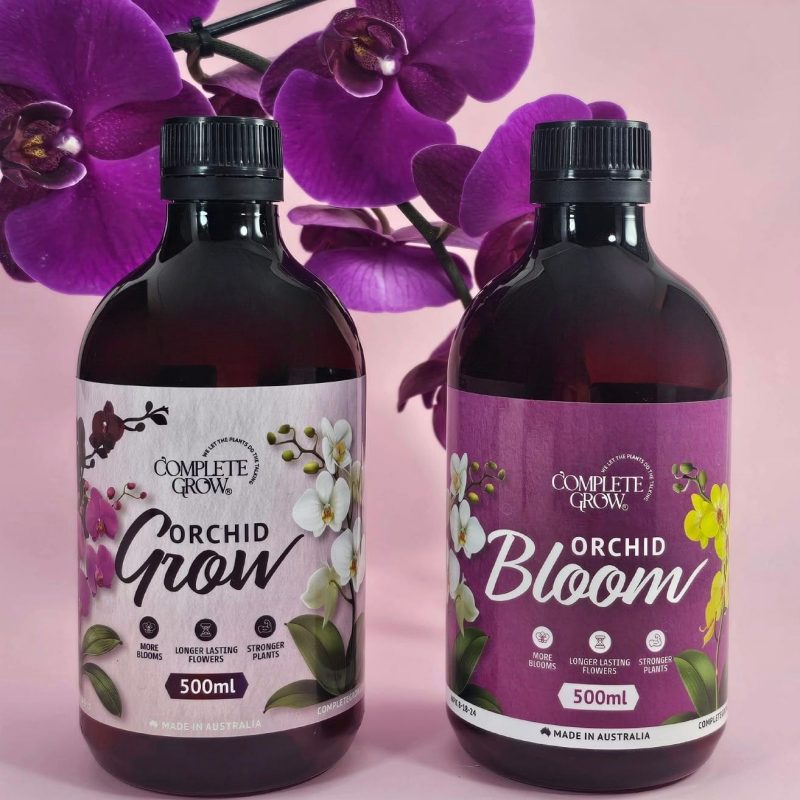
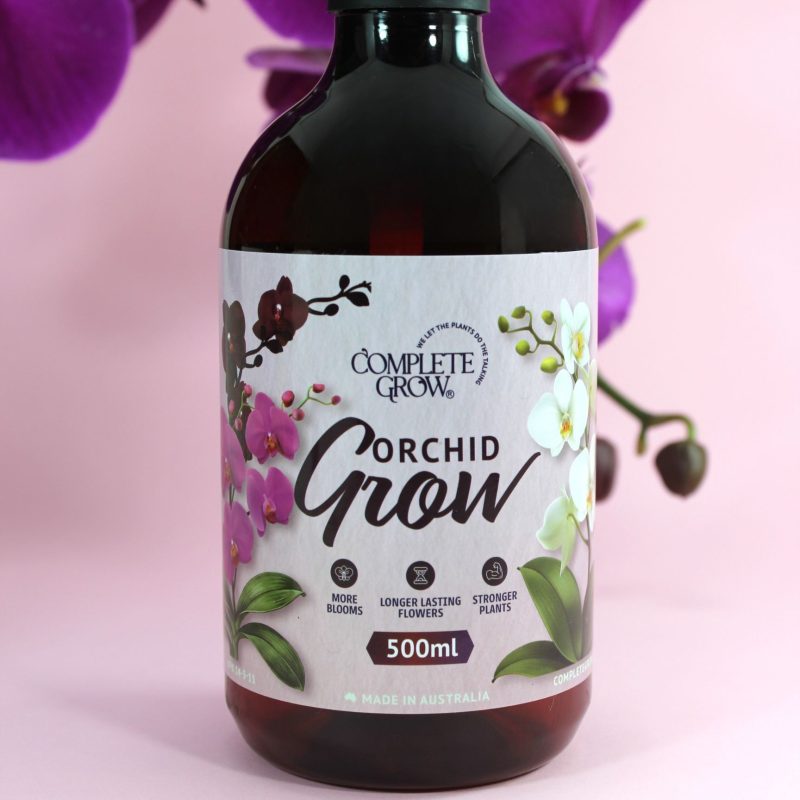
That is why the Orchid Grow and Bloom rate is 1 mL per litre at every watering, with a plain-water flush once a month, rather than a stronger dose less often.
What Is the Best Fertilizer for Orchids?
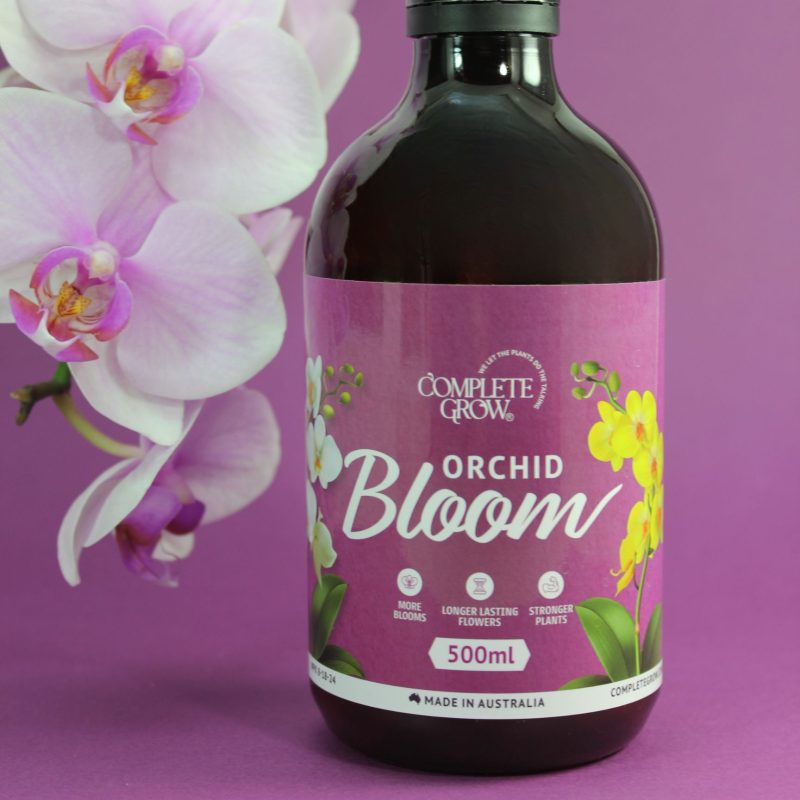
Orchids need a two-stage feeding schedule matched to their growth cycle: NPK 14-3-11 for healthy roots, leaves, shoots, and pseudobulbs during active growth, followed by high-phosphorus, high-potassium NPK 8-18-24 when flower spikes appear and throughout blooming.- NPK 14-3-11 – Use after flowering and while the orchid is producing new roots, leaves, shoots, or pseudobulbs.
- NPK 8-18-24 – Switch when the first flower spike appears and continue throughout bud development and flowering until the final flower finishes.
WHY ORCHID FERTILISER SHOULD BE UREA-FREE
Orchids grow best when most of their nitrogen comes as nitrate. A research review on phalaenopsis (moth orchids) recommends choosing a fertiliser with nitrate as the main nitrogen source. Plants given most of their nitrogen as ammonium grew smaller, produced smaller flowers and took up less calcium and magnesium.
Urea works against that. Before most of it is useful, urea has to be broken down into ammonium by the enzyme urease, in the roots and in microbes living in the potting mix. So a urea-based feed ends up as an ammonium-heavy feed, and in an open bark mix or on a mount, much of the urea can wash straight through the pot before it is converted.
Check the label. Many general-purpose plant foods, and some fertilisers sold for orchids, still use urea as a nitrogen source because it is cheap. Look for nitrogen listed “as urea”. Orchid Grow and Orchid Bloom contain no urea.
Source: Wang & Chang (2017), “Effects of nitrogen and the various forms of nitrogen on phalaenopsis orchid: a review”, HortTechnology 27(2): 144–149.
COMPLETE GROW’S VIEW: RAINWATER IS GREAT FOR ORCHIDS, BUT IT CARRIES NO CALCIUM OR MAGNESIUM
Many Australian orchid growers water from a rainwater tank, and for good reason: rainwater has almost no dissolved salts, so it is gentle on salt-sensitive roots. The catch is that it also has almost no calcium or magnesium, the two minerals tap water often supplies by accident.
Calcium builds the cell walls of new root tips and leaves, and magnesium sits at the centre of every chlorophyll molecule. On rainwater, the fertiliser is the only reliable source of both. That is why both orchid formulas include calcium and magnesium, so the feed works whether you water from the tank or the tap.
Fertilising Tips for Specific Orchid Types
- Phalaenopsis: Use NPK 14-3-11 while new roots and leaves are developing. Switch to NPK 8-18-24 when the first flower spike appears and continue until flowering finishes.
- Cymbidium: Use NPK 14-3-11 while new leaves, shoots, and pseudobulbs are developing. Switch to NPK 8-18-24 when flower spikes emerge.
- Cattleya: Use NPK 14-3-11 from the appearance of new roots and shoots while pseudobulbs mature. Switch to NPK 8-18-24 when a flower sheath, spike, or developing buds appear.
Recommended Orchid Fertiliser Schedule for Australia
Orchids need a feeding schedule matched to their growth stage, using NPK 14-3-11 for roots, leaves, shoots, and pseudobulbs, then switching to high-phosphorus, high-potassium NPK 8-18-24 when flower spikes appear.- Spring (Active Growth): Apply NPK 14-3-11 to support new roots, leaves, shoots, and pseudobulbs.
- Summer (Growth to Spike Development): Continue with NPK 14-3-11 while the orchid is producing vegetative growth. Switch to NPK 8-18-24 if a flower spike, sheath, or developing buds appear.
- Autumn (Spike and Bud Development): Cooler nights can trigger flower spikes in phalaenopsis, while cymbidium spikes may also become visible. Switch to NPK 8-18-24 at the first clear sign of a flower spike.
- Winter (Budding and Flowering): Continue with NPK 8-18-24 while the orchid is carrying spikes, buds, or open flowers.
- After Flowering: Return to NPK 14-3-11 when flowering finishes and the next cycle of root and foliage growth begins.
COMPLETE GROW’S VIEW: THE SPIKE IS YOUR SWITCH, NOT THE CALENDAR
The same orchid can spike in April one year and June the next, depending on how quickly the nights cool down. So switch formulas when you see the spike, not on a set date.
On a phalaenopsis, a new root tip is round, smooth and silvery-green, and it usually heads down or out. A flower spike has a flattened tip shaped like a mitten, grows out from under a leaf near the base, then turns up towards the light. On a cymbidium, a flower spike is round and plump, while a new leaf growth is flat and fans open.
Switch to NPK 8-18-24 the week you see the mitten, keep it going until the last flower drops, then return to NPK 14-3-11. That is when the orchid starts building the leaves and roots that will carry its next spike.
COMPLETE GROW’S VIEW: ORCHIDS NEED TWO DIFFERENT NUTRIENT PROFILES
An orchid performs two different jobs during its growth cycle. While producing roots, leaves, shoots, and pseudobulbs, it requires a growth-focused nutrient profile led by nitrogen. Once a flower spike appears, its priority shifts to developing buds and flowers, increasing the importance of phosphorus and potassium. That is why the program uses NPK 14-3-11 during vegetative growth and NPK 8-18-24 from flower-spike development through flowering. One general-purpose formula used throughout the year cannot target both stages as precisely. Orchids have salt-sensitive roots, but this does not mean they require nutrient-free feeding. In commercial production, actively growing orchids—particularly cymbidiums—can behave as demanding feeders. The aim is to provide targeted nutrition through controlled, regular feeding without allowing fertiliser salts to accumulate around the roots. For comparison, one commonly sold orchid bloom concentrate publishes N-P-K figures of 1.8-0.6-2.4. A simple concentrate-to-concentrate comparison shows that NPK 8-18-24 has a phosphorus figure 30 times higher and a potassium figure 10 times higher. Its nitrogen figure is approximately 4.4 times higher. This comparison uses the N-P-K figures published for the undiluted concentrates. It is a numerical label comparisonor a claim. Application rates and analysis methods may differ.Controlled Orchid Trial: Dural, NSW
An internal controlled side-by-side trial was conducted at an orchid and flower-growing operation in Dural, NSW. The comparison group continued using the same orchid fertiliser applied during previous seasons, while the trial group followed a two-stage program using NPK 14-3-11 during vegetative growth and NPK 8-18-24 from flower-spike development. In this trial, the two-stage group produced blooms measured at approximately 15% larger than those in the comparison group. The grower also recorded a greater number of flowers remaining presentable for longer, extending the saleable flowering period and providing more time to market and sell the orchids. The two-stage program therefore outperformed the comparison feeding program on the bloom-size and saleable-flower-longevity measures recorded during this trial. Results relate to one internal controlled commercial trial in Dural, NSW and are not a guarantee of identical results in every crop. Performance can vary with orchid variety, crop stage, temperature, light, water quality, growing media, and other management conditions.Is Homemade Fertiliser Good for Orchids?
Homemade fertilisers like banana peel water or rice water lack precise nutrient levels and often miss calcium, magnesium, and essential trace elements. For safe, consistent feeding—especially around delicate orchid roots—use a purpose-formulated liquid orchid fertiliser with clearly stated NPK values.Simple Orchid Feeding Routine
- NPK 14-3-11 – Use after flowering and during active root, leaf, shoot, and pseudobulb growth.
- NPK 8-18-24 – Switch when the first flower spike appears and continue throughout budding and flowering.
- Monthly flush: Run plain water through the orchid media once a month to help remove accumulated fertiliser salts.
Recommended Products
Orchid Pro Grow & Bloom Duo Liquid orchid fertiliser for leaves, roots and flowers 2 × 500 mL concentrates · Makes 1,000 L
The Grow Blog
Seasonal tips from our growers, written for real Aussie gardens.