
In a side-by-side backyard trial, a tomato fed CompleteGrow Advanced Formula 4-18-38 grew roughly 25–40% bigger than an identical plant on a generic store-bought fertiliser, carried more fruit, and fully recovered after its stem was snapped. Advanced Formula is a three-part tomato feed: a high-potassium NPK 4-18-38 with boron and chelated trace elements, plus separate Calcium Nitrate and Magnesium Sulphate. It gives tomatoes the potassium they need for fruit, the calcium that guards against blossom end rot, and nutrients that are fully dissolved and ready for the roots. See Advanced Formula 4-18-38.
Grower trial · Tomatoes
One feed swap. A visibly bigger tomato.
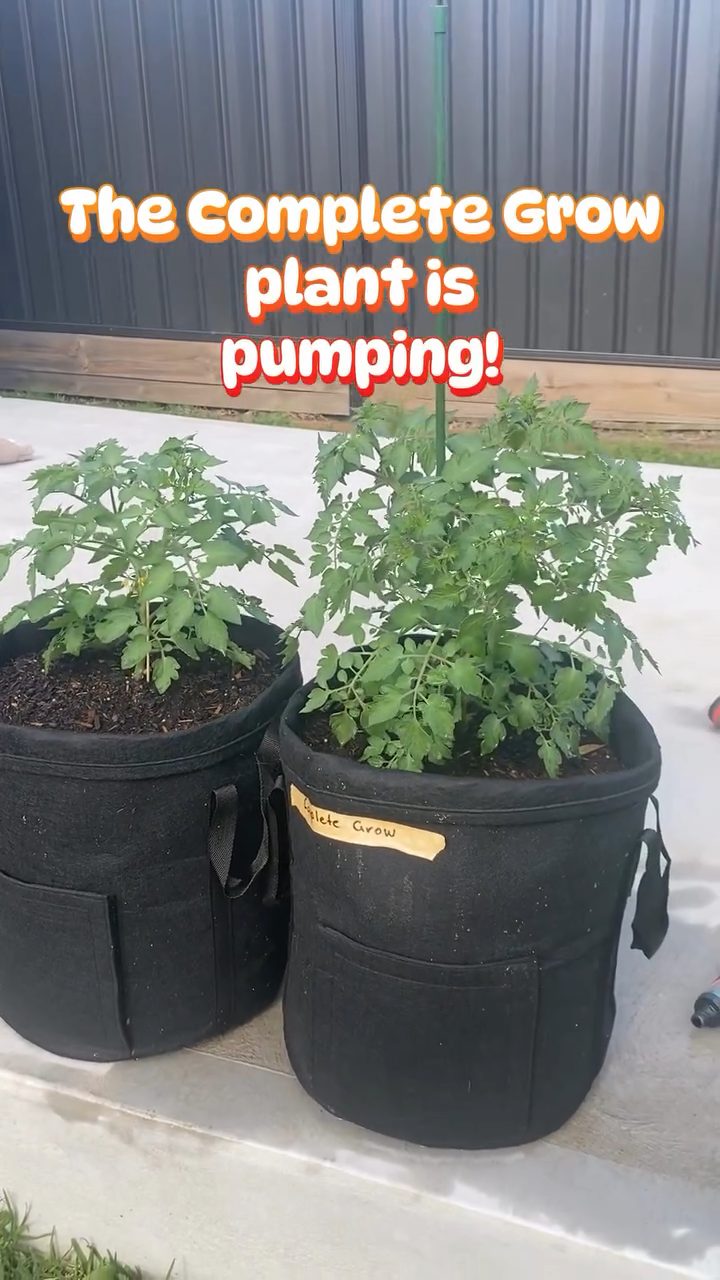
Rhys Wilson, the gardener behind The Grower's Guide, planted two tomatoes in matching grow bags and lined them up against the same fence. One was fed a generic fertiliser off a store shelf. The other was fed CompleteGrow Advanced Formula 4-18-38. You don't need to read the label to tell which is which.
- Size+25–40%bigger plant, judged by eye
- FruitMore fruitheavier trusses of green tomatoes
- RecoveryFull recoveryafter the stem snapped mid-season
 Store-bought
Advanced Formula
 Recovered after the snap
Photos: Rhys Wilson, @thegrowersguide_
The setup
Two tomatoes. Same bags, same spot, different feed.
Most fertiliser claims come from whoever's selling the fertiliser. This one came from a backyard. Rhys Wilson shares his home growing on Instagram as The Grower's Guide (@thegrowersguide_), and he set up the simplest test there is: grow two of the same plant side by side and change one thing.
Both tomatoes went into the same black fabric grow bags, sitting next to each other on the same patch of ground, so they got the same sun, wind and weather. The bag on the right has a strip of masking tape that reads “Complete Grow”. That plant was fed CompleteGrow Advanced Formula 4-18-38. The plant on the left was fed a generic, store-bought fertiliser.
| Grower | Rhys Wilson, The Grower's Guide (@thegrowersguide_) |
|---|---|
| Crop | Tomatoes, two plants |
| Containers | Matching black fabric grow bags |
| Position | Side by side, same sun and weather |
| Left plant | Generic store-bought fertiliser (brand not named) |
| Right plant | CompleteGrow Advanced Formula 4-18-38: NPK 4-18-38 + Calcium Nitrate + Magnesium Sulphate |
| How it was judged | Filmed through the season and compared by eye |
| Result | Roughly 25–40% bigger, more fruit, and a full recovery after a snapped stem |
Watch the trial
See the difference for yourself.
Rhys filmed both plants from early growth through to fruiting. Here's his reel.
Video not showing? Watch Rhys's reel on Instagram
What the trial showed
Bigger, more fruit, and a full recovery.
Three things stand out in Rhys's footage.
A bigger, fuller plant
Side by side, the Advanced Formula tomato is taller, with a wider and denser canopy. We've put the gap at roughly 25–40% by eye. It's a visual estimate, not a measurement, but it isn't a subtle one.
Heavier trusses
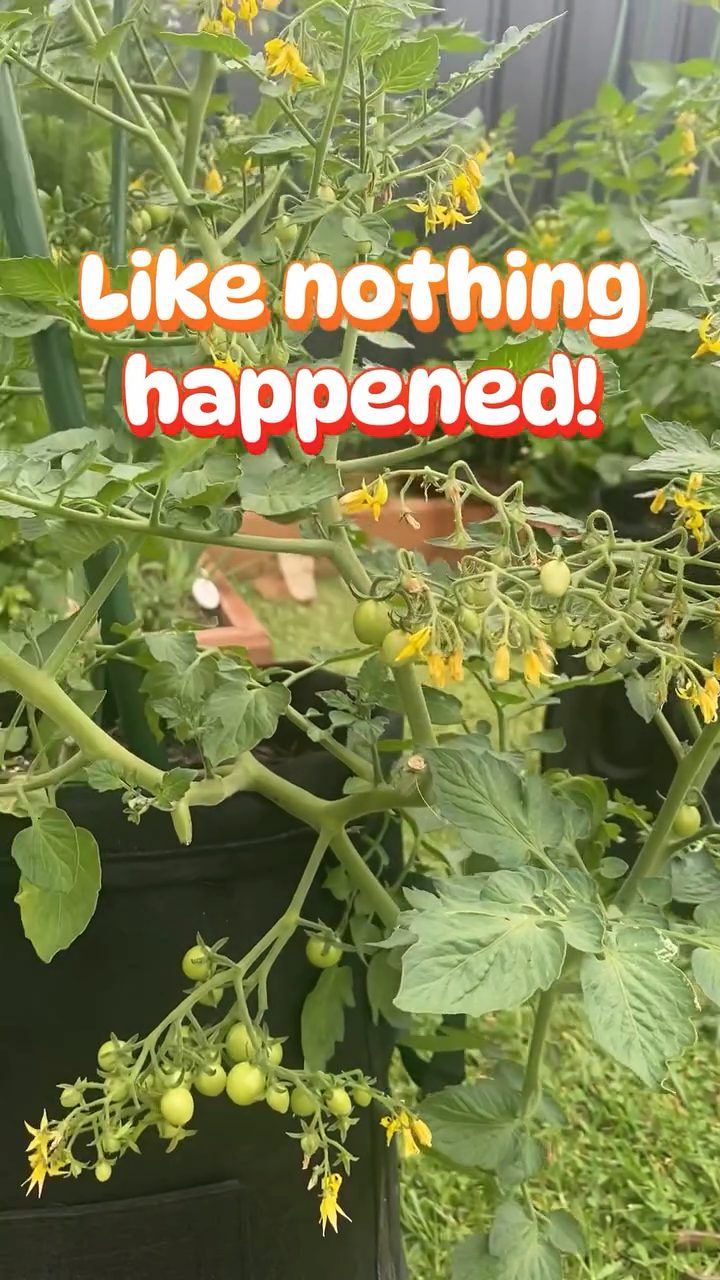
By fruiting time it's carrying long trusses of green tomatoes, with fresh yellow flowers still opening above them. That's noticeably more fruit than the plant on the store-bought feed.
Snapped, then back to fruiting
Partway through the season, the stem got snapped. Rhys's next update: “Like nothing happened.” New growth filled the gap, and the plant kept flowering and setting fruit.
How a snapped tomato comes back
- SnappedThe stem breaks mid-season.
- New shootsBuds at the leaf joints push new growth.
- Back in flowerFresh flower trusses open.
- Setting fruitTrusses fill with green tomatoes.
Why a well-fed tomato bounces back
Every leaf joint on a tomato holds a dormant bud. Lose a stem and the plant pushes those buds into new shoots. How fast that happens comes down to what the plant has in reserve: a strong root system, nitrogen and magnesium to build new leaves, calcium for new cell walls, and boron for the fresh growing tips. Advanced Formula supplies all of them. A plant that's been fed well all season has them on hand. An underfed one has to wait.
The tomato NPK, explained
What 4-18-38 means for a tomato.
Every fertiliser label carries three numbers: the percentage of nitrogen (N), phosphate (P) and potash (K) by weight. Advanced Formula's base powder is 4-18-38. That's a little nitrogen, a solid dose of phosphate and a lot of potassium, built around what a tomato spends most of its life doing: flowering and filling fruit.
Leaves and stems
Kept low on purpose so the plant doesn't run to leaf. The Calcium Nitrate part tops it up with fast-acting nitrate nitrogen.
Roots and flowers
Powers root growth and energy transfer, helping young plants establish and keeping flower trusses coming.
Fruit size and flavour
Drives fruit size, sugars, colour and even ripening. It's the nutrient fruiting tomatoes are hungriest for.
Researchers call potassium the “quality element” for tomatoes. Raising it in the feed has been shown to lift both yield and fruit quality, and in one trial the number of fruit per plant tended to rise with potassium supply while unevenly ripened fruit became less common. That's the logic behind a 4-18-38: give a fruiting tomato the potassium it's asking for, without the extra nitrogen that would push leaves instead.
Where each nutrient goes
- 1Leaves and stems: N + MgNitrogen builds new growth. Magnesium sits at the centre of every chlorophyll molecule, the green that turns sunlight into sugar.From: NPK 4-18-38, Calcium Nitrate, Magnesium Sulphate
- 2Roots: PPhosphorus fuels root growth, so the plant can take up water and every other nutrient.From: NPK 4-18-38 (18% phosphate)
- 3Flowers: P + boronBoron lets pollen germinate, which is how a flower becomes a tomato.From: NPK 4-18-38 (0.40% boron)
- 4Fruit: K + CaPotassium fills fruit with sugars and colour. Calcium builds firm cell walls and guards against blossom end rot.From: NPK 4-18-38 (38% potash) + Calcium Nitrate
| Nutrient | What it does in a tomato | Signs it's running short | In Advanced Formula |
|---|---|---|---|
| NNitrogen | Builds leaves and stems | Pale, yellowing older leaves; slow growth | NPK 4-18-38 (4%) + Calcium Nitrate |
| PPhosphorus | Roots, energy and flowering | Purple tinge under the leaves; slow, weak flowering | NPK 4-18-38 (18% phosphate) |
| KPotassium | Fruit size, sugars, colour and even ripening | Scorched edges on older leaves; blotchy ripening, yellow shoulders | NPK 4-18-38 (38% potash) |
| CaCalcium | Firm cell walls in fruit and new growth | Blossom end rot; distorted new leaves (calcium deficiency guide) | Calcium Nitrate (separate part) |
| MgMagnesium | Chlorophyll, the green in every leaf | Yellowing between the veins of older leaves (magnesium deficiency guide) | Magnesium Sulphate (separate part) + 0.22% in the base |
| BBoron | Pollen, fruit set and growing tips | Flowers dropping, poor fruit set, brittle tips | NPK 4-18-38 (0.40%) |
| FeIron, manganese, zinc, copper | Chlorophyll and growth enzymes | Yellowing new leaves with green veins | NPK 4-18-38, all chelated |
| MoMolybdenum | Helps the plant use nitrogen | Pale, mottled older leaves | NPK 4-18-38 (0.02%) |
Why it pulled ahead
Why Advanced Formula outgrew the store-bought feed.
We don't know exactly what's in the other bottle, and we won't guess. But one-bottle, general-purpose fertilisers tend to come up short in the same few places, and those are exactly the places tomatoes are fussy about.
-
It's built for fruit, not just leaves
With 38% potash and 18% phosphate, Advanced Formula puts most of its weight behind flowering and fruit, where a balanced all-rounder spreads it evenly. Much of the nitrogen comes from the separate Calcium Nitrate, in fast-acting nitrate form, so the plant gets enough to grow without the excess that pushes leaves at the fruit's expense. Too much nitrogen can also make blossom end rot worse.
-
Calcium and magnesium come built in
Calcium is hard to fit into a one-bottle fertiliser, because it reacts with phosphate and sulphate in concentrate and drops out as a solid. So plenty of general feeds leave it out. Advanced Formula supplies it as its own part, Calcium Nitrate, along with Magnesium Sulphate for the magnesium in chlorophyll. Calcium builds firm fruit and new growth, and a shortage in developing fruit is what causes blossom end rot.
-
Boron and chelated trace elements are in the base
The NPK 4-18-38 powder carries 0.40% boron, plus chelated iron, manganese, zinc and copper, and molybdenum. Chelated means each metal is wrapped in a carrier that keeps it dissolved and available to the roots, instead of locking up in the potting mix.
Boron is the one tomato growers notice most, because flowers need it to set fruit. In one field study, tomatoes given boron set about 56% of their flowers, against about 40% for plants that went without.
-
Everything dissolves, so the roots get it straight away
All CompleteGrow fertilisers are made to run in hydroponic systems, where there's no soil to fall back on: if a nutrient doesn't dissolve, the plant never gets it. So ours dissolve completely and leave no residue.
That matters even more in a grow bag. Fabric bags breathe and drain fast, so they dry out sooner than plastic pots, and every watering carries some nutrients out the bottom. A fully soluble feed reaches the roots the day you apply it, instead of waiting on moisture, warmth or soil life to break it down.
-
It's what commercial growers use
Our hydroponic formulas have been used on commercial farms for more than 25 years, and Advanced Formula is the bloom-stage feed behind the grape and rose results above. Rhys's grow bags show the same thing at backyard scale: a plant that never runs short grows bigger, sets more fruit and copes better when something goes wrong.
Side by side
Advanced Formula vs a typical store-bought feed.
Most store-bought fruit and flower fertilisers are a weak N-P-K blend and not much else: no calcium, no magnesium and few trace elements. Advanced Formula is made for one job: getting the most fruit out of a flowering plant. Here's what that difference looks like, nutrient by nutrient.
- Weak N-P-K blend
- No calcium or magnesium
- Missing key trace elements

- Three-part system built for flowers and fruit
- Calcium, magnesium and boron built in
- Hydroponic-grade, Australian owned and made
Tomato nutrients covered
A fruiting tomato draws on all 12 of these.
| What tomatoes need | Typical store-bought | PremiumAdvanced Formula 4-18-38 |
|---|---|---|
| KFruit-focused N-P-K | A weak, low-strength N-P-K blend |
NPK 4-18-38: about 63% of the N-P-K is potassium for fruit size and flavour |
| CaCalcium for firm fruit | Usually left out of one-bottle feeds |
Separate Calcium Nitrate part to guard against blossom end rot |
| MgMagnesium for green leaves | Often not listed |
Magnesium Sulphate part, plus 0.22% in the base |
| BBoron for fruit set | Often not stated on the label |
0.40% boron, so more flowers turn into fruit |
| FeTrace elements | A few, if any |
Chelated iron, manganese, zinc and copper, plus molybdenum |
| Dissolves completely | Varies; granules wait on moisture and warmth to break down |
Hydroponic-grade: dissolves clean with no residue |
| Rates for each stage | One rate, all season |
Seedling and full-strength rates from planting to harvest |
| Track record | Garden-shelf product |
25+ years on commercial farms |
| Rhys's side-by-side trial | Smaller plant, less fruit |
+25–40% bigger, more fruit, full recovery after a snap |
The store-bought column describes common store-bought fruit and flower fertilisers, not any one brand. Formulas vary, so check the label on yours. Advanced Formula figures come from its guaranteed analysis.
- Australian owned & mademade for Aussie gardens
- Hydroponic-gradedissolves clean, no residue
- Chelated trace elementsstay available to the roots
- 25+ yearson commercial farms
A basic fruit feed covers the N-P-K. Advanced Formula covers everything the fruit needs.
Shop Advanced Formula 4-18-38How to use it
Three parts, three buckets.
Advanced Formula comes as three separate packs. Each one is dissolved in its own water and applied on its own. It takes a couple of extra minutes, and it's the reason every nutrient arrives at the roots intact.
Apply in order: 1→2→3 · one scoop holds about 6 g · never mix the three together
Why the three parts are kept apart
Commercial growers keep calcium in its own tank for the same reason, apart from anything containing phosphate or sulphate. Advanced Formula just brings that habit to the backyard.
Using a hose-end sprayer instead
Make each part up to 1 L in the sprayer bottle and set the dial to A: 200 g NPK 4-18-38 with 800 mL of water, 100 g Calcium Nitrate with 900 mL, or 50 g Magnesium Sulphate with 950 mL. Spray them in the same order, rinsing the bottle and sprayer with clean water between parts. The Fruit & Flower Fertiliser Bundle comes with the sprayer.
Your season plan
Feed your tomatoes the way Rhys did.
Here's the season with Advanced Formula, from planting out to the last pick. It works in pots, grow bags and garden beds.
Seedlings: start at the seedling rate
Dissolve 6 g NPK 4-18-38, 6 g Calcium Nitrate and 3 g Magnesium Sulphate, each in its own 10 litres of water, and pour them around the base one after another.
Growing strongly: step up to full strength
Move to 8 g, 8 g and 4 g per 10 litres and keep going through flowering and fruiting. Feed every 1–2 weeks through to harvest.
Water evenly, every time
Blossom end rot happens when calcium can't reach the developing fruit, and uneven watering is the most common cause. Grow bags dry out fast, so check them daily in hot weather, water before the mix dries right out, and mulch the top.
Stake and tie as it grows
A plant carrying more fruit is a heavier plant. Tie the main stem to a stake as it grows and support heavy trusses, so a gust or a bump doesn't snap it.
Run your own side-by-side
Copy Rhys: two plants of the same variety, two identical pots, the same mix, the same spot and the same watering. Change only the fertiliser, and photograph both from the same position each week.
Want extra leafy growth first? Some growers start young plants on All Purpose NPK 20-20-20 and switch to Advanced Formula when the first flower buds appear. Stop one before you start the other, and don't run both at full strength together.
Questions
Tomato feeding questions, answered.
What is the best NPK for tomatoes?
Once tomatoes start flowering, a high-potassium feed such as 4-18-38 suits them best, because potassium drives fruit size, sugars and colour. Pair it with calcium to guard against blossom end rot, and with magnesium for healthy leaves. CompleteGrow Advanced Formula 4-18-38 supplies all three as separate parts, with seedling and full-strength rates, so you can use it from planting to harvest.
What does 4-18-38 mean on a fertiliser?
It's the percentage by weight of nitrogen (4% N), phosphate (18% P₂O₅) and potash (38% K₂O). In practical terms, about 63% of the N-P-K in the bag is potassium, the nutrient fruiting tomatoes are hungriest for.
Is 4-18-38 enough nitrogen for tomatoes?
On its own the nitrogen is low by design, so the plant doesn't put its energy into leaves at the fruit's expense. In Advanced Formula, the Calcium Nitrate part adds fast-acting nitrate nitrogen alongside the calcium, so the system feeds leafy growth as well as fruit.
Why are the three parts of Advanced Formula applied separately?
Calcium reacts with phosphate and sulphate when they're mixed in concentrated form, forming solids such as gypsum that the plant can't use and that can block sprayers. Dissolving each part in its own water keeps every nutrient available.
How much Advanced Formula 4-18-38 do I use on tomatoes?
Per 10 litres of water: 8 g NPK 4-18-38, 8 g Calcium Nitrate and 4 g Magnesium Sulphate, each dissolved in its own 10 litres and applied in that order. Use 6 g, 6 g and 3 g for seedlings. Feed every 1–2 weeks through to harvest.
What's the best fertiliser for tomatoes in grow bags?
A fully water-soluble feed with calcium and trace elements, applied every week or two. Grow bags drain fast, so little and often works better than an occasional heavy dose. In Rhys Wilson's side-by-side trial, the tomato fed Advanced Formula 4-18-38 grew roughly 25–40% bigger than one on a store-bought fertiliser.
Will a snapped tomato plant recover?
Usually, yes. If the stem is only partly broken, line it back up, splint it with a stick and wrap it firmly with tape; tomato stems often knit back together. If it's snapped clean through, trim below the break and let the side shoots take over. Keep feeding and watering evenly while it regrows.
Grow the bigger plant
Give your tomatoes the Advanced Formula side.
The same three-part feed Rhys used. Get it on its own, or in the Fruit & Flower Bundle with 4 kg of Advanced Formula and a hose-end sprayer.
Where to next.
Sources
- Rhys Wilson (@thegrowersguide_), tomato fertiliser trial reel, Instagram. instagram.com/reel/DfjORa8TcCf
- CompleteGrow, Advanced Formula NPK 4-18-38 + Calcium & Magnesium: guaranteed analysis and directions for use. completegrow.com.au
- “Effects of Potassium Supply in Nutrient Solution on Water and Nutrient Absorption of Substrate-Grown Tomato Plants”, Horticulturae 11(6), MDPI. mdpi.com
- “Some responses of tomatoes to the concentration of potassium in recirculating nutrient solutions”, Acta Horticulturae 178, ISHS. ishs.org
- Naz, R.M.M. et al., “Effect of boron on the flowering and fruiting of tomato”, Sarhad Journal of Agriculture. Fruit set of 55.83% with 2 kg B/ha against 39.77% for the untreated control. PDF
- Iowa State University Extension, “Blossom End Rot”. yardandgarden.extension.iastate.edu
- University of Georgia Extension, “What's That Problem: Blossom End Rot”. site.extension.uga.edu
recommended by our growers
What we'd use
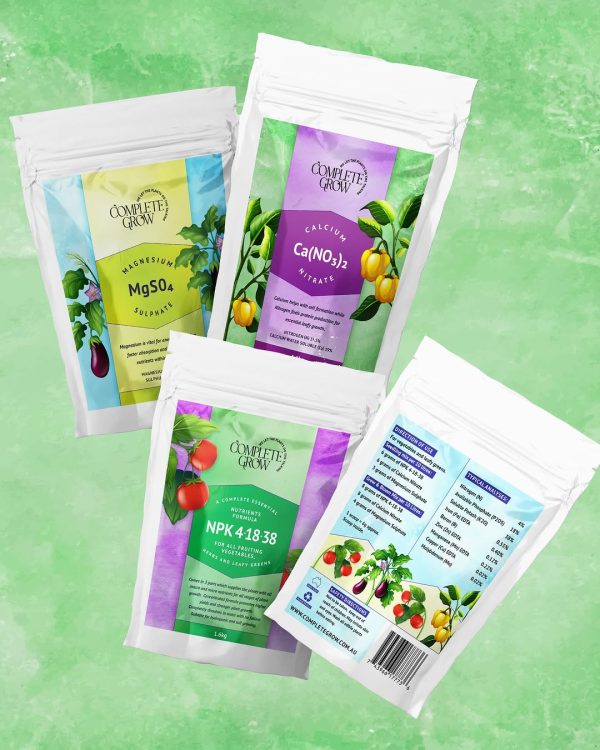
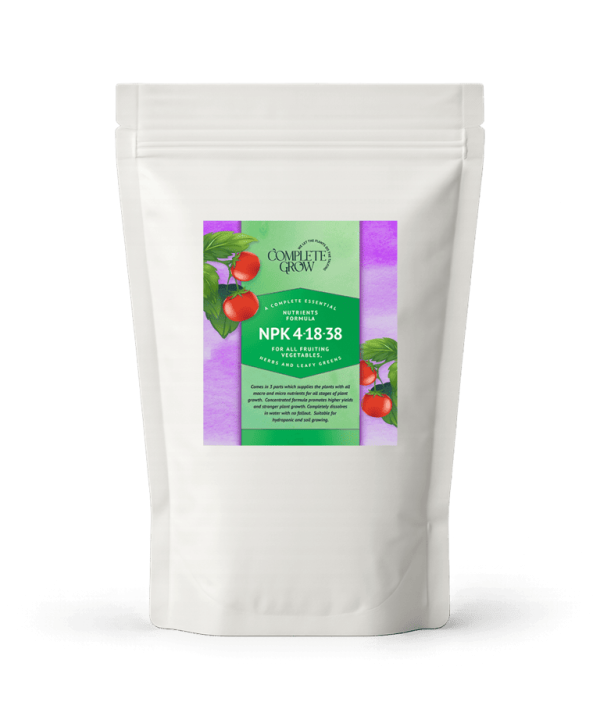
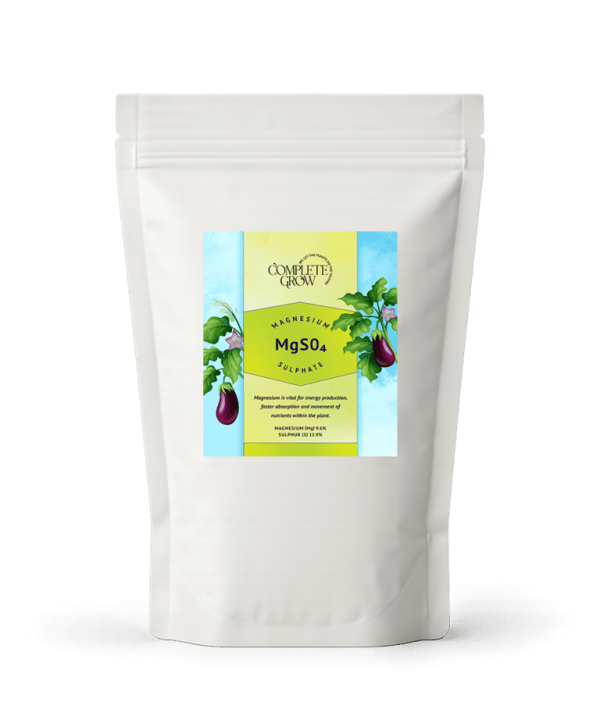
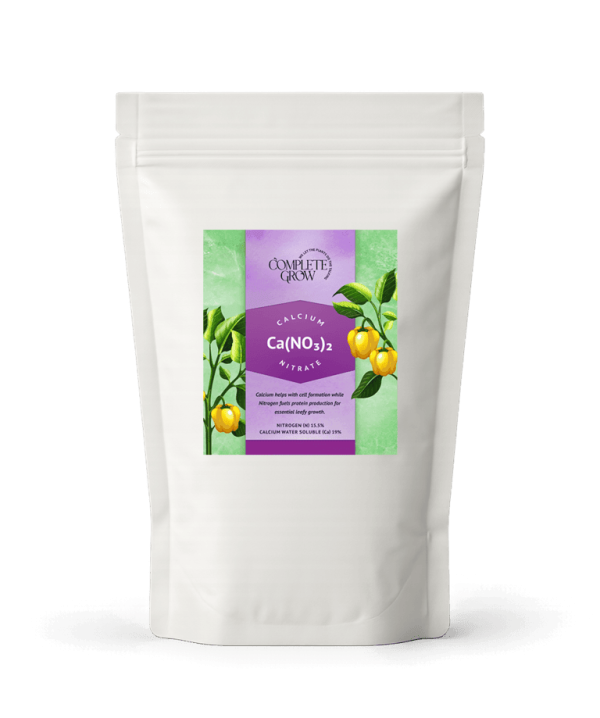
Powder · NPK 4-18-38
Advanced Formula for
Flowering & FruitingNPK 4-18-38 + Calcium & Magnesium
A complete 3-part nutrient system for bigger blooms, heavier fruit set and stronger colour, from first flower to harvest.
5.0