
CompleteGrow fertiliser buying guide
The True Cost of $5 Supermarket Fertiliser (And What's Actually Inside)
A $5 fertiliser is cheap for a reason. It is built to hit a low shelf price, not to compete with a premium, high-concentration plant nutrition formula.
The bottle may look like a bargain, but what matters is how much actual nutrition is inside it: NPK strength, dilution, micronutrients, solubility and the quality of the formulation.
The $5 fertiliser problem
A cheap bottle is usually a cheaper formulation
A low-cost supermarket plant food is not a premium concentrate being sold at a huge discount. To reach a bargain shelf price, budget formulas commonly rely on lower nutrient density, simpler formulations and less expensive formulation choices.
Cheap liquid fertilisers are mostly plain water. You end up paying for heavy bottle volume instead of actual plant food. Other brands sell you water. CompleteGrow gives you concentrated plant nutrition.
Why does it cost $5?
You get what you pay for
Lower-cost liquids can contain less concentrated nutrition per litre, leaving you to buy and transport more water with the nutrients.
A cheaper bottle can deliver less declared NPK per litre of concentrate than a stronger premium formulation.
Budget feeds may use a simpler micronutrient package or disclose fewer premium formulation features.
The goal is affordability and mass-market convenience. CompleteGrow is built around formulation strength instead.
What's really inside?
The bottle size tells you almost nothing
A one-litre bottle of weak liquid feed and a one-litre bottle of concentrated plant food are not equivalent. The useful comparison is the amount and quality of nutrition packed into that litre.
Liquid fertiliser needs water and formulation aids. The question is how much of the bottle is carrying nutrients versus how much active nutrition is actually present.
Higher guaranteed percentages mean more primary nutrient is packed into the concentrate. This is one of the fastest ways to separate a weak feed from a strong one.
NPK is only the beginning. Iron, manganese, zinc, boron, copper and molybdenum are all essential nutrients that matter in a complete formulation.
Chelation can help selected metal micronutrients remain soluble and available under suitable conditions. CompleteGrow declares chelated manganese.
Cheap shelf feed vs CompleteGrow
They're not built for the same job
Budget shelf fertiliser is made to be easy to buy. CompleteGrow is made for growers who want a stronger, more complete and more controllable feeding system.
What changes when you stop comparing the price tag?
The supermarket trick
Compare the plant food, not the water volume
Cheap brands want you to look at bottle size or how many litres of diluted mix it makes. But if that mix is super weak, you're mostly paying to transport and pour water.
The real math
A $5 bottle might claim to make 100 litres of feed—but if that feed is heavily diluted, your plants still aren't getting much nutrition. A strong concentrate costs more upfront, but delivers far more actual nutrients per capful.
A bargain per litre of water is not a bargain per unit of plant food.
The CompleteGrow standard
More of what your plants actually need.
Concentrated plant nutrition with essential micronutrients, considered nutrient forms and the flexibility to feed across different growing systems.
High-concentration nutrition
You dilute the concentrate yourself, giving you concentrated plant nutrition without relying on a large volume of weak prepared feed.
Six essential micronutrients
Boron, copper, iron, manganese, molybdenum and zinc are declared alongside the primary nutrients for a broader nutrient profile.
Chelated manganese
A considered micronutrient package that goes beyond simply listing NPK on the front of the bottle.
Australian made
CompleteGrow gives Australian growers a locally made fertiliser option with clearly declared nutrient specifications.
Hard proof
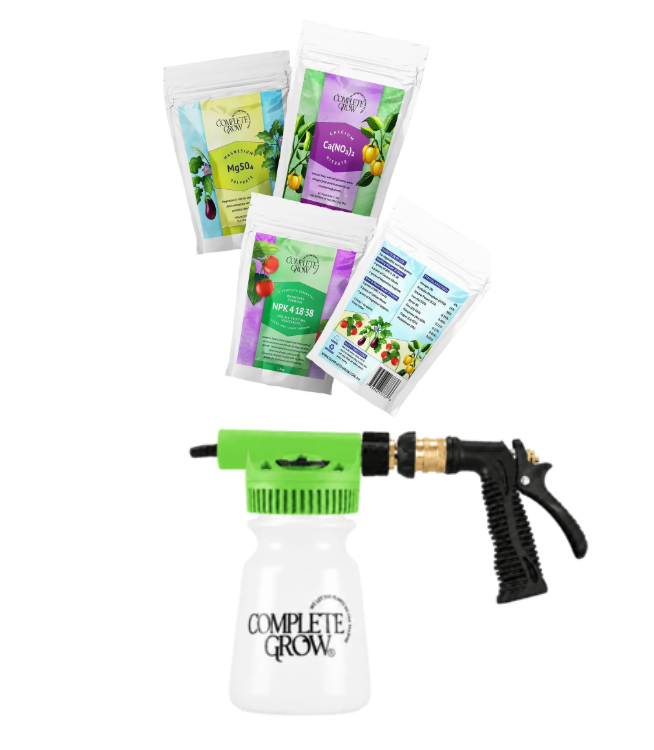
CompleteGrow also offers a true 20-20-20 powder
CompleteGrow NPK 20-20-20 Powder has a genuine guaranteed analysis of 20% nitrogen, 20% phosphate and 20% potash.
It also includes six essential micronutrients and is manufactured from high-purity material. This is exactly the kind of specification you should be looking for when comparing premium fertiliser with a bargain shelf product.
What are you actually paying for?
Cheaper fertiliser often means more filler and less active nutrition
A low shelf price usually has to come from somewhere. In cheaper liquid fertilisers, that can mean more water, carriers and non-nutrient material relative to the amount of active plant nutrition.
In simple terms: the cheaper the formula, the more likely you are paying for filler instead of concentrated nutrients.
Budget formulas can contain a greater proportion of water, carriers and other non-nutrient material compared with a concentrated feed.
Less concentrated NPK means more product volume is required to deliver the same level of plant nutrition.
Cheaper formulations may provide basic NPK while offering fewer trace nutrients or less sophisticated micronutrient forms.
Budget fertiliser is formulated around affordability. CompleteGrow is formulated around nutrient concentration and performance.
CompleteGrow combines concentrated NPK with six essential micronutrients and chelated manganese, giving growers a more complete feeding formula with less emphasis on bulk volume.
Cheap fertiliser sells you volume. CompleteGrow sells you concentrated plant nutrition.
If all you want is the lowest possible checkout price, a budget supermarket feed will always be tempting.
But if you compare nutrient concentration, micronutrients, chelation, raw-material quality, solubility and feeding flexibility, CompleteGrow is operating in a different class.
Don't buy the cheapest bottle. Buy the stronger formulation.
Quick answers
Cheap fertiliser FAQs
Why is some supermarket fertiliser so cheap?
Budget formulas are designed around affordability. Depending on the product, that can mean lower nutrient concentration, greater dilution or a simpler formulation.
Does cheap fertiliser contain filler?
Liquid fertilisers contain water and can include non-nutrient carriers or formulation aids. The useful comparison is how much declared active nutrition remains in the finished product.
Are imported fertilisers automatically poor quality?
No. Country of origin alone does not prove quality. The important difference is whether the manufacturer publishes a strong, transparent nutrient specification. CompleteGrow also gives Australian growers a locally made option.
Why is CompleteGrow positioned as premium?
CompleteGrow focuses on concentrated plant nutrition, six essential micronutrients, chelated manganese, water-soluble feeding options and Australian manufacture. Its powder also provides a genuine guaranteed 20-20-20 analysis.