
New from CompleteGrow · October 2026
Introducing Orchid Grow & Bloom.
Two urea-free formulas. Makes 1,000 litres of orchid feed.
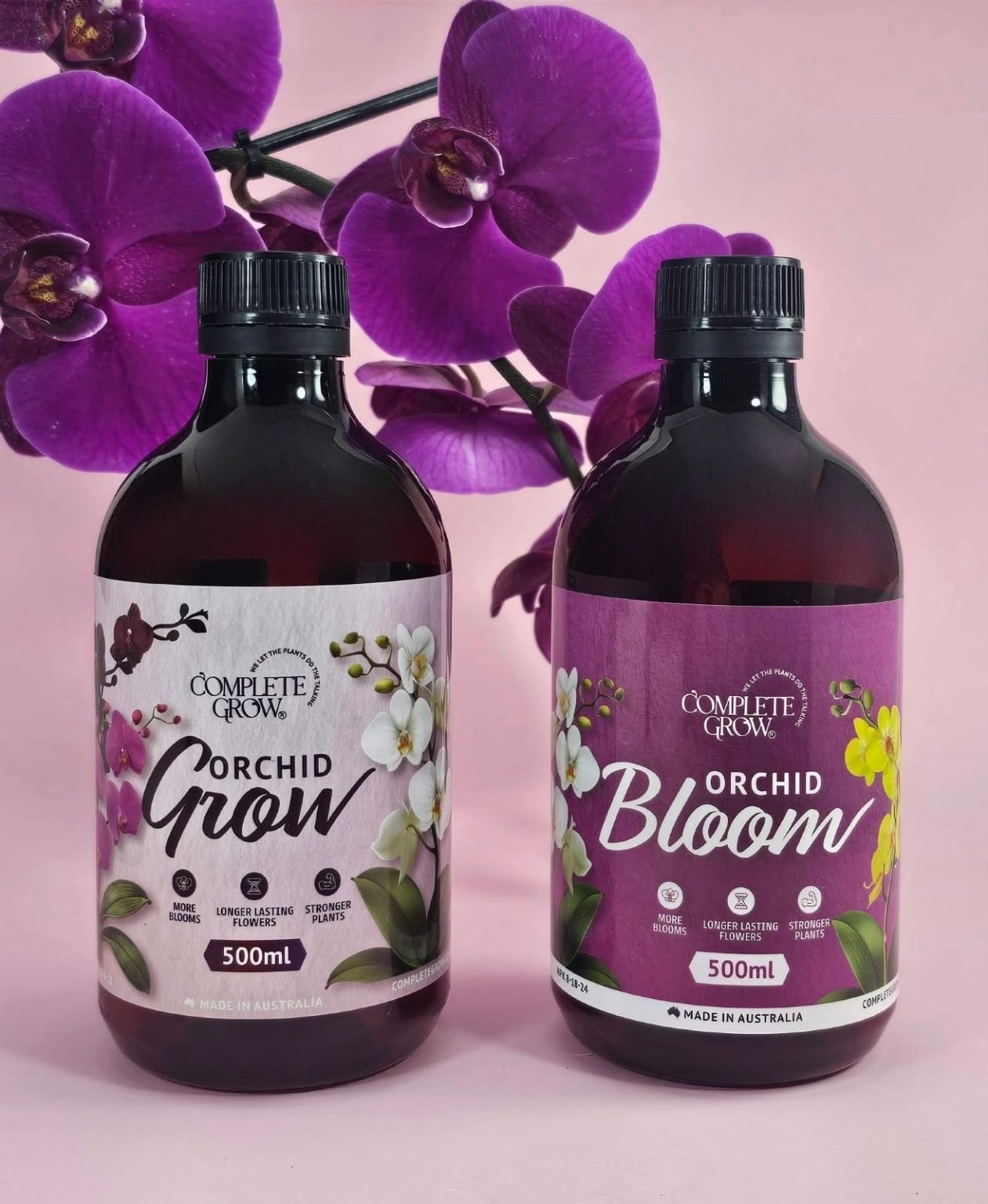
Meet our new two-stage orchid fertiliser. Just 1 mL per litre from either bottle prepares 500 L of Grow and 500 L of Bloom, used at their respective stages.
The thinking behind the launch
The flowers are only part of the story.
It’s easy to pay attention to an orchid when it’s covered in flowers. The less glamorous part comes afterwards: a new leaf, a fresh root tip, and a plant that still needs care while you wait for its next display.
We wanted the feeding routine to feel clear through both stages. Orchid Grow & Bloom pairs a growth formula with a flowering formula, using the first flower spike as your cue to switch.
The formulation matters just as much as knowing which bottle to pick. We think an orchid feed should make it easy to understand what’s inside. That starts with a detail the NPK numbers alone can’t explain.
A deliberate choice in both formulas
Some orchid fertilisers contain urea. Ours don’t.
“For orchids” tells you what a feed is sold for. It doesn’t tell you whether there’s urea inside.
Read the label in 3 steps
Look beyond NPK. Check for urea.
The NPK number shows how much nitrogen a feed contains, not whether any of it comes from urea. Here’s how to check.
-
The front label
Start with the first number.
The first NPK number gives the declared nitrogen percentage. On Orchid Grow, that’s 14%. It doesn’t tell you which form that nitrogen takes, or whether any of it is urea.
- N Nitrogen
- P Phosphorus
- K Potassium
-
The fine print
Check for urea.
Nitrate, ammonium and urea are all forms of nitrogen. To see whether a feed contains urea, look for a urea-free statement, or check the ingredients or the manufacturer’s composition information. [5]
Look for: a clear urea-free claim, or urea listed in the ingredients. Not clear? Ask the manufacturer.
-
Our formulas
Ours: urea left out.
Grow for leaves and roots; Bloom from the first flower spike. Our choice to leave urea out stays the same at both stages. [1]
- Grow NPK 14–3–11
- Bloom NPK 8–18–24
- Both 1 mL per litre
Both formulas are urea-free. Urea-free still supplies nitrogen: 14% in Grow, 8% in Bloom.
The word “orchid” alone doesn’t tell you whether a feed contains urea. In the comparison below, Feed A’s manufacturer lists urea in its composition information; Feed B is described by its manufacturer as urea-free. [4]
The American Orchid Society’s basic care guide recommends feeds containing little or no urea. We chose to leave it out of both Orchid Grow and Orchid Bloom. [5]
What urea-free tells you.
Urea-free is a clear feature you can check. It does not prove that every urea-containing feed is unsuitable: controlled research with young moth orchids grown in sterile laboratory conditions found that their roots could absorb urea directly. That study was not a comparison of these commercial products. Our position is to offer a urea-free option with a clearly explained routine. [6]
A useful shopping habit: check for urea as well as the headline NPK. Look for a urea-free statement or check the ingredients. If it isn’t clear, ask the manufacturer.
Choose by what your orchid is doing
A new spike is your cue to change bottles.
With our duo, you don’t need to choose a formula by the month on the calendar. Look at the plant: are you between flowering cycles, or is a flower spike developing?
01 · Growth
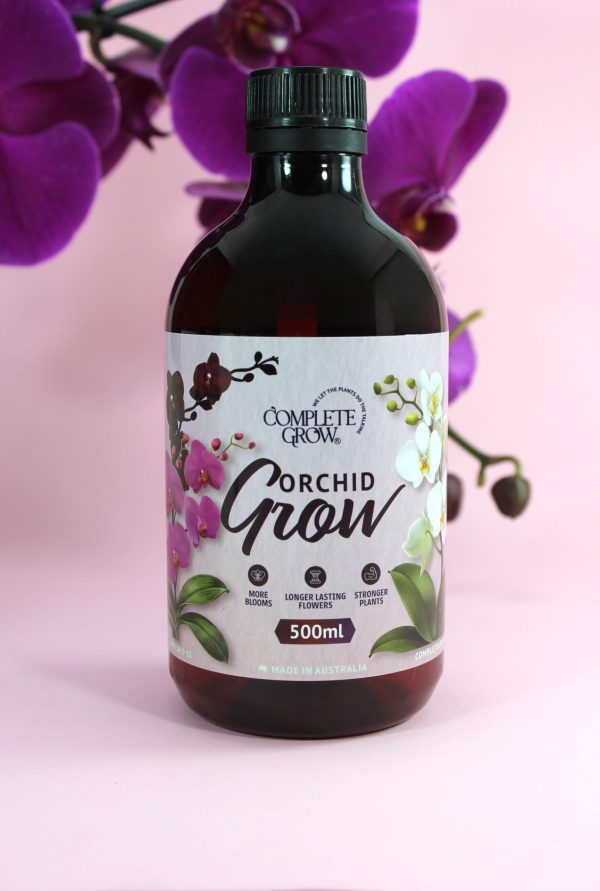
Orchid Grow
NPK 14–3–11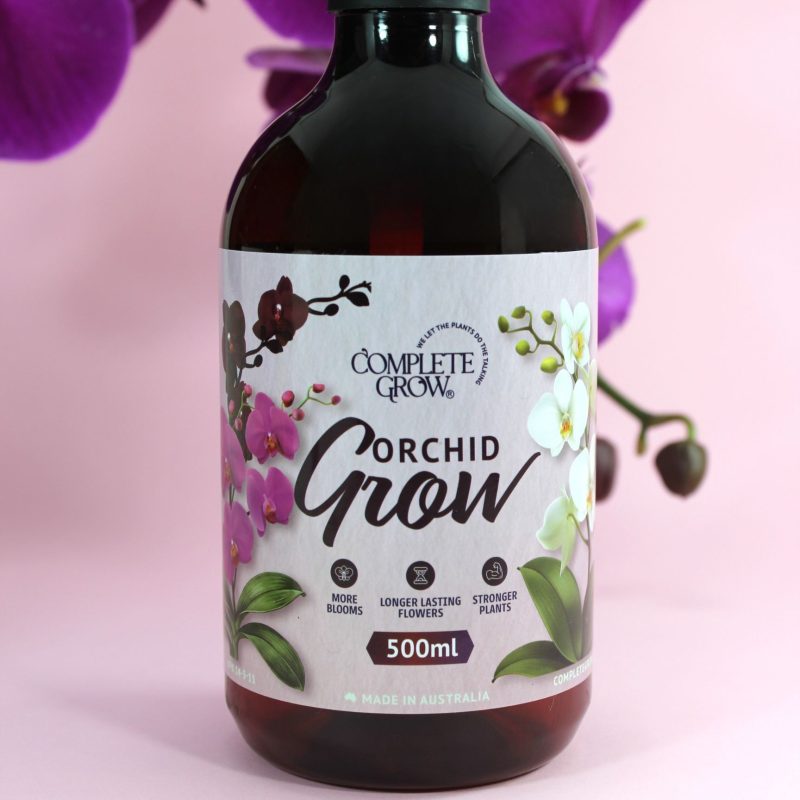
The nitrogen-led formula for the growth between flowerings. This is the stage when new leaves and roots deserve your attention, even while the flowers are absent.
02 · Flowering
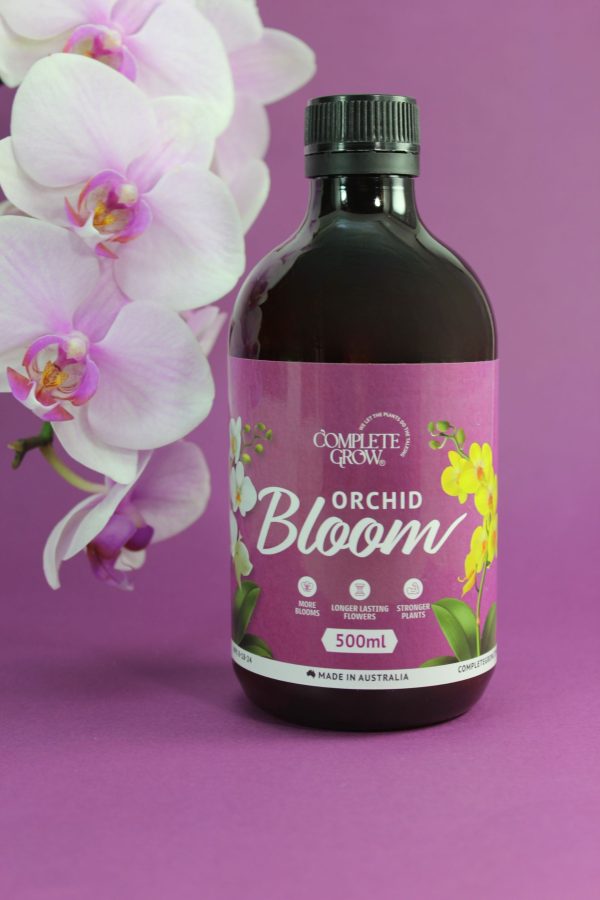
Orchid Bloom
NPK 8–18–24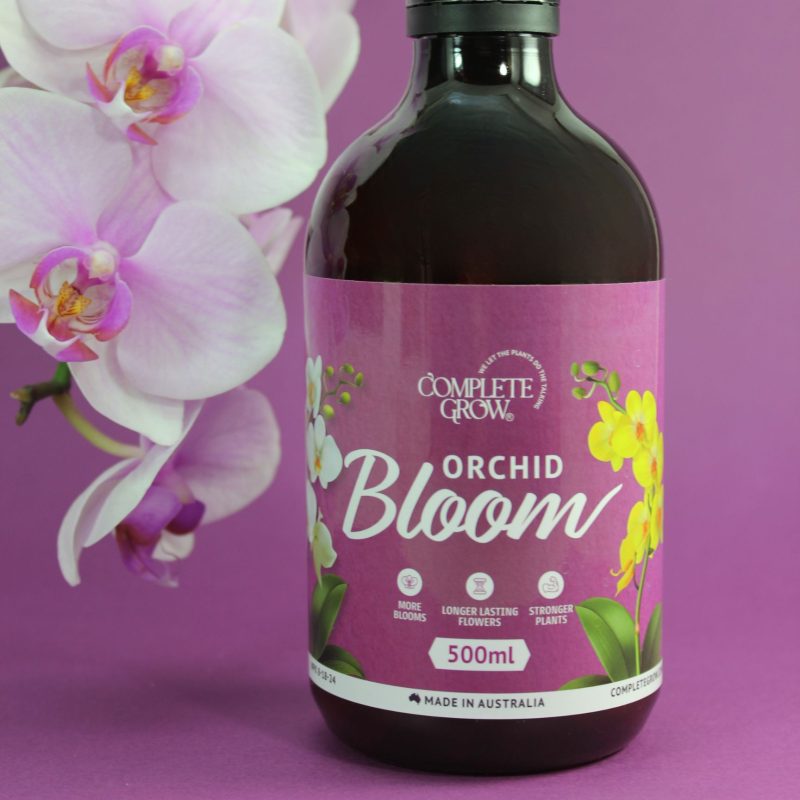
The flowering-stage formula, with a higher proportion of phosphorus and potassium than Grow. Use it from the first flower spike through to the final flower.
Use one formula at a time; do not combine the concentrates. NPK figures describe the concentrate (% w/v). Both formulas also include calcium, magnesium and six trace elements: iron, manganese, zinc, boron, copper and molybdenum. See the full analysis and directions.
Highly concentrated · just 1 mL per litre
One duo. 1,000 litres of orchid feed.
That’s 500 L from Orchid Grow plus 500 L from Orchid Bloom at our label rate. Two 500 mL bottles; 1,000 L of prepared feed across the two stages.
The mixing rate makes a substantial difference. From the same 1 L of total concentrate, our duo prepares about 3.33 times as much feed as selected feed A and 5 times as much as selected feed B, at their standard label rates. [3]
CompleteGrow · 2 × 500 mL duo
1,000 L500 L from Grow + 500 L from Bloom.
Use each formula at its respective stage.
Prepared feed from equal concentrate volumes
as selected feed A
as selected feed B*
Based on 1 L of total concentrate per option at standard label doses: 1,000 L versus 300 L and 200 L*. These ratios describe mixing yield, not an NPK or plant-performance multiplier.
The table compares two selected reference products, not the whole market. Its concentrate volumes are normalised; they are not the pack sizes sold. *Feed B’s additional monthly stronger dose is explained below.
Swipe to compare all three columns →
Prepared litres at the standard mixing rate
| What’s compared |
Orchid Grow & BloomOur two-formula duo |
|
|
|---|---|---|---|
| Urea in the formula | Urea-freeBoth Grow and Bloom | Urea listedIn manufacturer composition information | Urea-freeAs published by the manufacturer |
| Formula approach | Growth and flowering formulas | One formula for growth and flowering | Separate growth and flowering formulas |
| Published standard dose | 1 mL per litre | 30 mL in 9 litresApproximately 3.33 mL per litre | 5 mL per litreAlso recommends an 8 mL per litre dose monthly* |
| Feed from 500 mL of concentrate | 500 litres | 150 litres | 100 litres* |
| Feed from 1 L of total concentrate | 1,000 litresCombined yield across both 500 mL bottles | 300 litresNormalised to 1 L of concentrate | 200 litres*At the standard 5 mL per litre rate |
How to read this: prepared litres = concentrate volume ÷ label dose. Our 1 L total is two different 500 mL formulas used at different stages. *Feed B: its additional monthly stronger dose reduces the total prepared volume. Mixing yield does not establish equal nutrient delivery, feeding schedules, value or plant results. The × marks identify alternative illustrations, not safety or test ratings. Directions and composition checks: [3][4]
What the comparison helps you see
Read the formula, the dose and the routine together.
-
01 · The formula
Look beyond a single feature.
Read NPK alongside the mixing rate. Nutrient percentages vary by formula, so the prepared-feed ratios above are not a single “NPK strength” multiplier. Check calcium, magnesium and trace elements too.
-
02 · The dose
Count the watering cans.
The duo’s 1,000 L yield is two hundred 5 L mixes across Grow and Bloom at the label rate. That’s one hundred mixes from each bottle. Make only the amount your collection needs.
-
03 · The routine
Choose a routine you can follow.
Check when a feed should be applied, when to switch formulas and how to measure it. In our duo, both bottles use 1 mL per litre, so the dose stays familiar when the stage changes.
A small measure goes a long way
One measured cap. Five litres of orchid feed.
Small dose · substantial total yield
1,000 L, mixed as you need it.
A 1 L jug takes 1 mL. A 5 L can takes one measured 5 mL capful. The same low mixing rate applies to both bottles, giving 500 L from each formula and 1,000 L across the duo.
If you compare prices, start with cost per prepared litre at each product’s recommended dilution. Then consider the nutrient analysis and feeding frequency. That gives you more useful context than comparing the shelf prices of two bottles.
Bring it into your routine
At the next watering, start with the plant.
Here’s the feeding side of the routine. For everything else your orchid needs, from light to repotting, see the orchid care guide.
Look for the stage.
Use Grow between flowering cycles. Switch to Bloom when the first flower spike appears. After the final flower, return to Grow when no spikes or buds remain.
Measure the dose.
Shake the chosen bottle, then add 1 mL per litre of water. Use one formula at a time and keep the concentrates separate.
Water and drain.
Follow the product directions at watering time and allow excess liquid to drain. Once a month, use plain water to flush the mix.
A few things you might be wondering
Before the first feed.
Can an orchid fertiliser contain urea?
Yes. “For orchids” does not mean a formula is urea-free. Look for a urea-free statement or check the composition information. If it isn’t clear, ask the manufacturer. Both CompleteGrow formulas are urea-free.
Does urea-free mean other feeds cannot work?
No. Research has shown that moth orchid roots can absorb urea directly under controlled laboratory conditions. Urea-free describes our formulation choice. The full formula, dose and growing conditions also matter. See the research reference.
Do I use Grow and Bloom together?
No. Choose one for the current stage. Don’t combine the concentrates.
When do I go back to Grow?
After the final flower drops, when there are no remaining flower spikes or buds. Use the full product directions for your feeding routine.
Does preparing more litres mean better results?
Prepared litres measure mixing yield. They don’t establish that products supply equal nutrition or produce the same results. Use the comparison alongside the analysis and feeding directions.
recommended by our growers
What we'd use
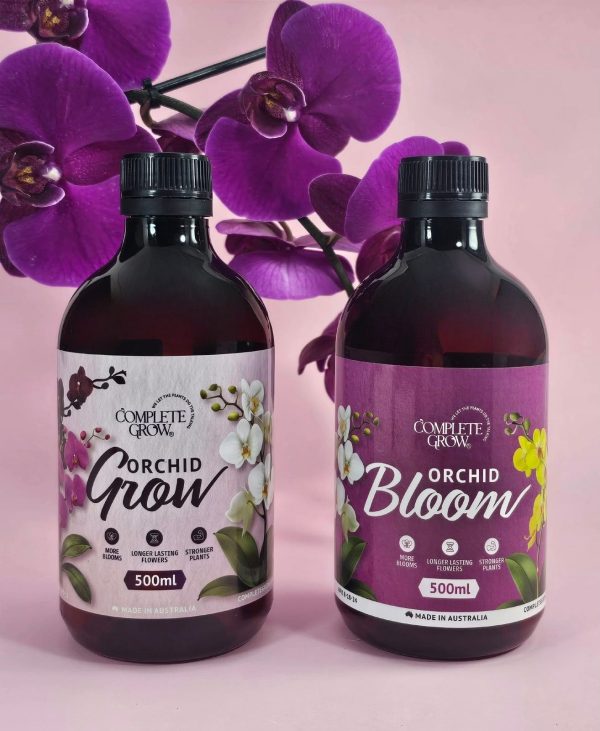
Liquid · 2 × 500 mL
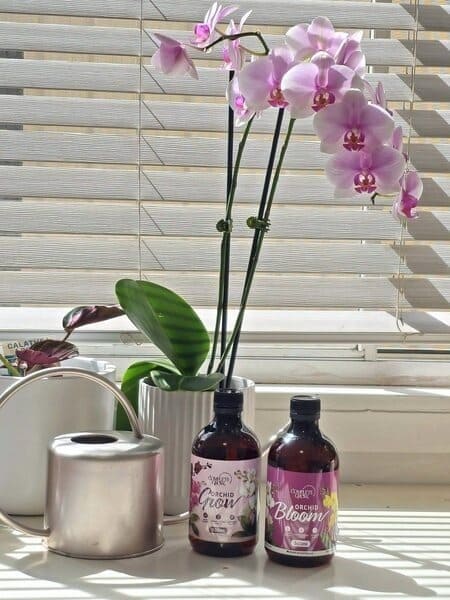
Orchid Grow & Bloom DuoLiquid orchid fertiliser for leaves, roots and flowers2 × 500 mL concentrates · Makes 1,000 L
Two specialised formulas for every stage: Grow for healthy leaves and roots; Bloom for strong spikes, more buds and longer-lasting flowers.Highly concentrated: just 1 mL…