
What Are Hydroponic Nutrients? A Complete Guide for Australian Growers
Hydroponic nutrients are the only food your plants get. With no soil to fall back on, every nutrient a plant needs has to come from the bottle and reach the roots through water. This guide covers what a complete hydroponic nutrient contains, why the good ones come in two parts, how much to add to your reservoir, and when you do (and don't) need Cal-Mag. It's built around our own Hydroponic Nutrients Two-Part Formula (A & B), which has been used commercially by our farmers for more than 25 years, from coco coir growers in Dural and the Hunter Valley to a partner farm in Fiji. The principles apply to any system.
Quick answer: for most home systems (DWC, NFT, drip, coco and recirculating setups), use a complete two-part nutrient at 3 mL of Part A and 3 mL of Part B per litre of water. Add Part A to the water first, mix, then add Part B. In Sydney tap water, expect an EC of about 1.5 to 2.0 mS/cm. Keep pH between 5.5 and 6.5, and don't add Cal-Mag on top of a complete A & B unless your plants or water show they need it. Avoid organic-based fertilisers in drip systems, as they can clog drippers and lines.
What's in a hydroponic nutrient?
Hydroponic nutrients are fully water-soluble mineral fertilisers made for growing without soil. In a garden bed, soil holds a reserve of minerals that plants can draw on. In a hydroponic system there's no reserve, so the nutrient solution has to supply everything:
- Major nutrients: nitrogen (N) for leaves and stems, phosphorus (P) for roots and flowers, and potassium (K) for fruit, flowering and overall strength.
- Secondary nutrients: calcium (Ca) for strong cell walls, magnesium (Mg) for green leaves, and sulphur (S).
- Trace elements: iron, manganese, zinc, boron, copper and molybdenum, needed in tiny amounts but still essential.
If a nutrient is missing from the bottle, it's missing from the plant. That's why a hydroponic nutrient has to be complete, not just high in NPK. If you're new to NPK numbers, our guide to understanding NPK ratios explains what they mean.
Why the best hydroponic nutrients come in two parts
A complete nutrient needs calcium, and it also needs sulphates and phosphates. The problem is that calcium reacts with them when they're concentrated together, forming solids that settle out of the solution and become unavailable to your plants. A single bottle can't hold all three at full strength without that happening.
A two-part system solves it by keeping calcium separate until the moment you dilute it. In our A & B, calcium is separated so it stays available to your plants. Once both parts are diluted in your reservoir, they sit together happily.
How to mix Part A and Part B
- Fill your reservoir or mixing container with water first.
- Add Part A at the correct rate and mix it thoroughly into the water.
- Add Part B only after Part A is fully dispersed, then mix again.
- Run the finished solution through your system, or apply it to your pots.
Never pour Part A straight into Part B, and never mix the two concentrates in the same measuring jug. Measure each part separately. If your reservoir ever turns cloudy or white sediment appears after mixing, the concentrates have usually met before they were diluted, and some of the calcium has dropped out of solution.
What's in CompleteGrow Hydroponic Nutrients (A & B)
Our two-part Hydroponic Nutrients were developed by hydroponic farmers, have been used commercially by our farmers for more than 25 years, and are made in Sydney. They're a complete base nutrient, so one A & B set carries plants from leafy growth through flowering and fruiting.
| Nutrient | Typical analysis (% w/w, formulation basis) |
|---|---|
| Nitrogen (N) | 25.6% |
| Phosphate (P) | 5.7% |
| Potassium (K) | 41.5% |
| Calcium (Ca) | 3% |
| Magnesium (Mg) | 1% |
| Sulphur (S) | 1.8% |
| Trace elements | Iron, manganese and zinc (EDTA chelated), boron, copper and molybdenum |
It's suitable for DWC, NFT, drip, coco and recirculating systems, and the same two bottles also feed pots and garden beds at a slightly higher rate.
Proven on commercial farms, from Sydney to Fiji
Our hydroponic fertiliser has been used by our farmers for more than 25 years. We work directly with growers across NSW, including in Dural, on Sydney's north-west fringe, and the Hunter Valley, using coco coir grow bags to improve hydroponic feeding as well as drip-fed crops in the ground. Here's what that work has produced:

| Where | Crop | Feeding | Result |
|---|---|---|---|
| Dural, NSW | Roses | Switched from his previous fertiliser to CompleteGrow All Purpose and Advanced Formula 4-18-38 | Blooms lasted a full two weeks longer, and 17% more roses |
| Hunter Valley, NSW | Grapes, in the ground with drip feeding | Two stages: All Purpose during growth, then Advanced Formula 4-18-38 from flowering | 15% more yield, measured over several seasons |
| Fiji | Lettuce and coriander (cilantro) | Our concentrated powder hydroponic nutrients, supplied through a partnership with the farmer | 20 to 30% more yield |
The grape result came from feeding by stage: a balanced feed while the vines are growing, then a bloom-focused feed once they flower. The table further down shows how to do the same with our range. Commercial growers can also order our concentrated powder hydroponic nutrients in bulk; contact us for a bulk enquiry.
How much to add to your reservoir
For hydroponic systems and seedlings, use 3 mL of Part A and 3 mL of Part B per litre of water. For pots and garden beds, use 4 mL of each per litre. Here's the hydroponic rate worked out for common reservoir sizes:
| Reservoir size | Part A | Part B |
|---|---|---|
| 1 L | 3 mL | 3 mL |
| 10 L tub | 30 mL | 30 mL |
| 20 L DWC bucket | 60 mL | 60 mL |
| 50 L reservoir | 150 mL | 150 mL |
| 100 L NFT or tower reservoir | 300 mL | 300 mL |
What EC to expect
Mixed at 3 mL + 3 mL per litre in Sydney tap water, our A & B reads about 1.5 to 2.0 mS/cm on an EC meter. If your reading is well outside that range, check your measurements and test your source water on its own.
How far a set goes
At the hydroponic rate of 3 mL + 3 mL per litre:
- 1 L A + 1 L B makes about 330 litres of nutrient solution, or roughly 16 fills of a 20 L bucket.
- 5 L A + 5 L B makes about 1,660 litres, or roughly 83 fills of a 20 L bucket.
- 20 L A + 20 L B makes about 6,660 litres, enough for 66 fills of a 100 L reservoir.
Do you need Cal-Mag with an A & B nutrient? Usually not.
A lot of hydroponic advice tells you to add Cal-Mag to every reservoir. With a complete two-part nutrient, that's usually doubling up: our A & B already contains calcium and magnesium, so there's no need to add Cal-Mag to it by default.
Our general rule is simple: don't add calcium, magnesium or other supplements automatically. Use them only when your water, your system or your plants show they're needed. Signs your plants may be short on calcium or magnesium include blossom end rot on tomatoes, tip burn on lettuce and leafy greens, and stunted new growth.
When Cal-Mag does make sense: if you're running a single-part feed that doesn't include calcium and magnesium, such as our All Purpose liquid, and especially if you're mixing with rainwater or filtered water, which contain very little of either. In that case, add Cal-Mag at 0.5 to 1 mL per litre, during both growth and flowering. Our guide to what Cal-Mag is and how to use it goes into more detail.
pH and water: the two things nutrients can't fix
Even a complete nutrient won't be absorbed properly if the basics are off.
- Keep pH between 5.5 and 6.5. Check it after mixing, not before, because adding nutrients changes it. A pH down solution is often needed in hydroponics. In Sydney tap water, our A & B usually mixes straight into the 5.5 to 6.5 range, so you'll only need it occasionally; when you do, our farmers use a phosphoric acid based pH down.
- Check your water first. Tap water can carry salts and chlorine. Measure the EC (electrical conductivity, a reading of how much dissolved mineral is in the water) of plain water before you add anything, so you know your starting point.
- Write your numbers down. Record EC and pH right after mixing, then check them again over the following days. If EC climbs, plants are drinking water faster than they're using nutrients, so top up with plain water. If EC falls, they're using nutrients quickly.
Which CompleteGrow fertiliser for your system?
Every product below is in our hydroponic nutrients range, so you can compare sizes and prices side by side.
| If you want... | Use | Rate |
|---|---|---|
| A complete base feed for any hydroponic system, from seedling to harvest | Hydroponic Nutrients (A & B) | 3 mL A + 3 mL B per litre |
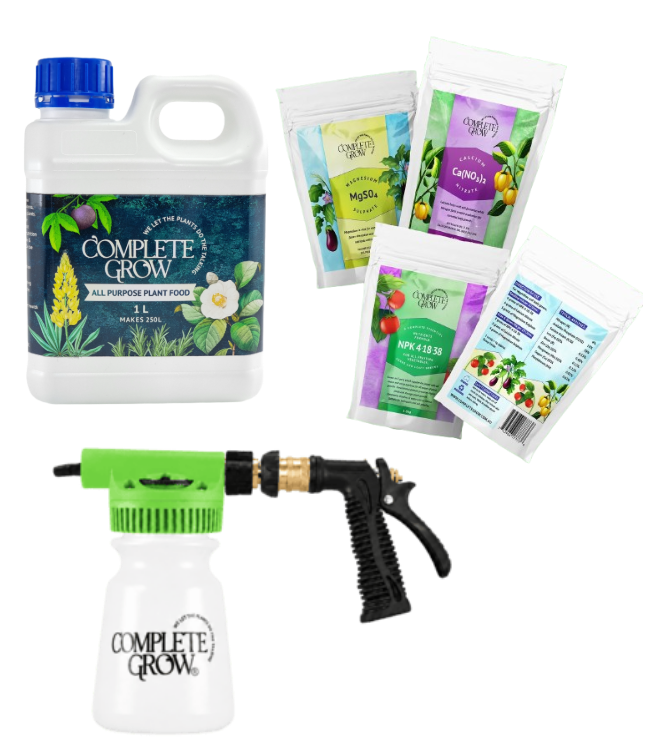
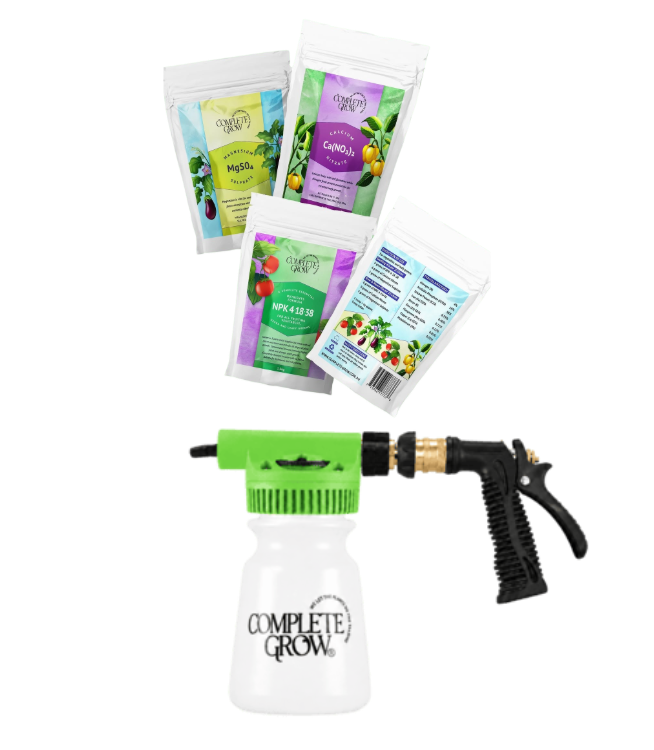
| A bloom-focused program for heavy flowering and fruiting crops | Advanced Formula 4-18-38, a three-part system with its own calcium nitrate and magnesium sulphate | Switch at first flower buds; see the product page for rates |
| One simple bottle for hydro, coco and the rest of the garden | All Purpose Liquid Plant Fertiliser | 4 mL per litre; monitor pH and EC |
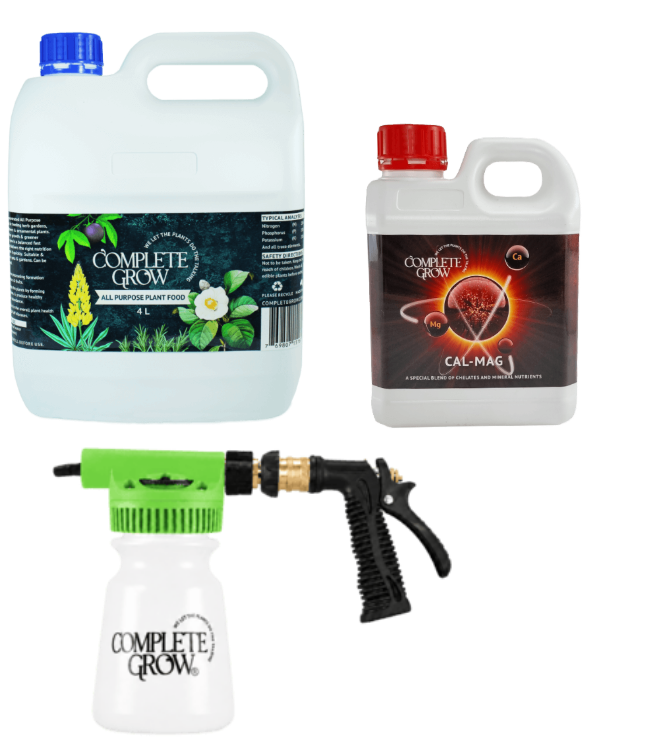
| Extra calcium and magnesium with a feed that doesn't contain them | Cal-Mag | 0.5 to 1 mL per litre |
With Advanced Formula 4-18-38, never combine the three dry powders or their concentrated solutions. Dissolve each one separately, just as you would with Part A and Part B.
Made to run clean in hydroponic systems
Every CompleteGrow fertiliser is designed to work in hydroponic systems. They're made from natural mineral raw materials and are fully water-soluble, so they dissolve clean with no residue, sludge or smell. That matters in hydroponics: undissolved particles and organic matter can block drippers, coat pumps and build up in NFT channels, and a reservoir that stays clear is far easier to keep healthy.
The CompleteGrow view: the most expensive mistake we see home hydro growers make is using an organic-based fertiliser, and it's one our commercial farmers never make. Organic feeds can clog drippers and lines, and we've seen it first-hand: one grower's drippers and lines blocked, and the pump failed as well, all needing expensive repairs. In a hydroponic system, use fully water-soluble mineral nutrients.
Common hydroponic nutrient mistakes
- Using organic-based fertiliser in a drip system. It can clog drippers and lines, and the repairs can be expensive. Stick to fully water-soluble mineral nutrients.
- Pouring Part A straight into Part B. The concentrates react and some nutrients become unavailable. Always dilute each one in water separately.
- Adding Cal-Mag to a complete A & B by default. If your base nutrient already contains calcium and magnesium, only add more when your plants or water show they need it.
- Using the garden rate in a hydro system. Our A & B garden rate is 4 mL + 4 mL per litre; hydroponic systems and seedlings take 3 mL + 3 mL.
- Overfeeding. More isn't better. Stick to the dilution rate to avoid nutrient burn.
- Ignoring pH. Outside 5.5 to 6.5, plants struggle to absorb nutrients even when they're in the water. Keep a pH down solution on hand for when it drifts out of range.
Hydroponic nutrient FAQs
What hydroponic nutrient should a beginner start with?
A complete two-part A & B nutrient. It covers every stage from seedling to harvest, so you only need to get one mixing routine right.
Can I mix Part A and Part B together ahead of time?
No. Always add each part to water separately. Once both are diluted in your reservoir, they're fine together.
Do I need Cal-Mag with an A & B nutrient?
Not by default. Our A & B already contains calcium and magnesium; add Cal-Mag only if your plants or water show they need it.
How much A & B do I add per litre?
3 mL of Part A and 3 mL of Part B per litre for hydroponic systems and seedlings, or 4 mL of each for pots and gardens.
What pH should my nutrient solution be?
Between 5.5 and 6.5. Check it after the nutrients are mixed in.
Do I need a pH down solution?
Keep one on hand. In Sydney tap water, our A & B usually mixes straight into the 5.5 to 6.5 range, so you'll only need pH down occasionally; our farmers use a phosphoric acid based one.
What EC should A & B read?
About 1.5 to 2.0 mS/cm when mixed at 3 mL + 3 mL per litre in Sydney tap water.
Can I use organic fertiliser in a hydroponic system?
We don't recommend it. Organic-based fertilisers can clog drippers and lines, which can mean expensive repairs, so use fully water-soluble mineral nutrients instead.
How long does a 1 L A & B set last?
At the hydroponic rate, a 1 L + 1 L set makes about 330 litres of nutrient solution.
Can I use hydroponic nutrients in soil or pots?
Yes. Our A & B feeds pots and garden beds at 4 mL of each part per litre.
Ready to set up your reservoir?
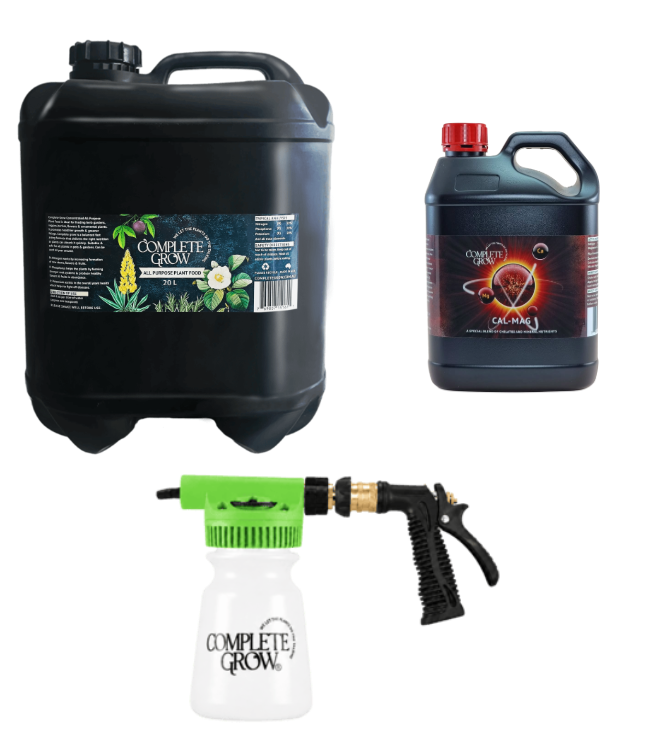
Start with a complete base nutrient and get the mixing routine right. CompleteGrow Hydroponic Nutrients (A & B) come in 1 L, 5 L and 20 L sets, made in Sydney and used commercially by our farmers for more than 25 years. You can also browse all our hydroponic nutrients, including Cal-Mag and the 20 L bulk A & B set. For larger operations, our concentrated powder hydroponic nutrients are available by bulk enquiry.
Not sure what your system needs? Ask our team or call us on (02) 9053 1426.
recommended by our growers
What we'd use
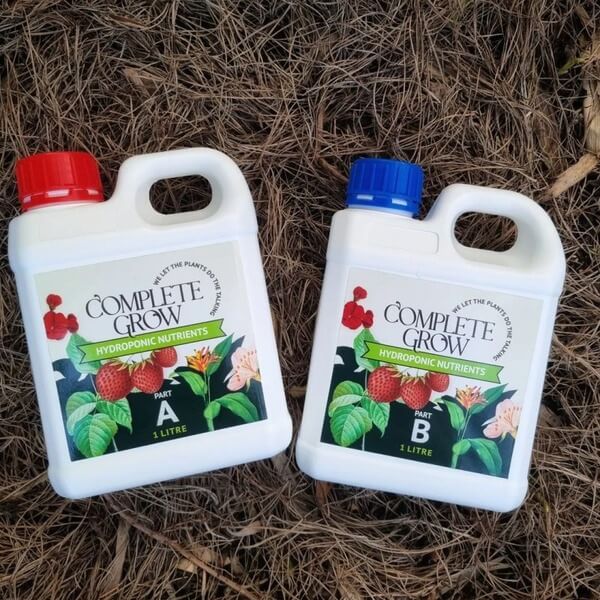
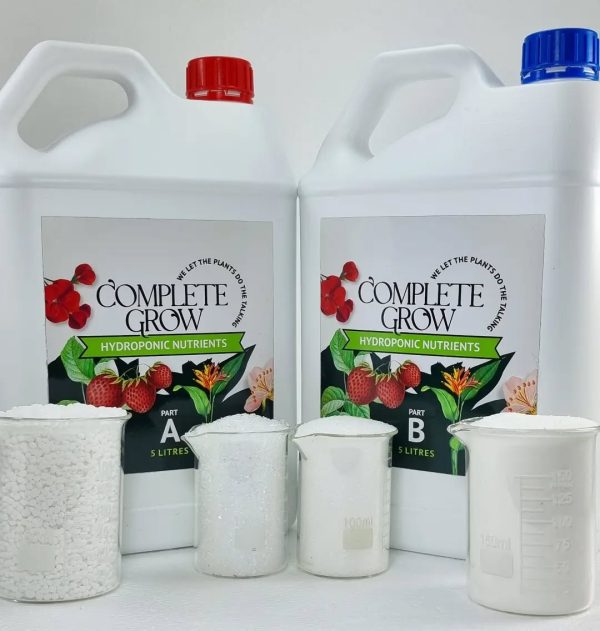

Liquid
Hydroponic Nutrients FertilizerTwo-Part Formula (A & B)Complete base nutrient system for hydroponic growing
High-performance two-part hydroponic nutrients engineered for faster uptake, cleaner reservoirs, and stronger results.
5.0